Questions
Questions, answered from official pages.
Two height tables, the 2017 Atlas additions, and a few unusual official captions.
Who classified clouds, officially, on the Met Office page?
Luke Howard, a London pharmacist and amateur meteorologist, in 1802, in The Modifications of Clouds. The WMO later extended that system to ten genera. [source]
How high are the genera?
It depends which official Met Office page you open. British Isles table: low usually below 6,500 ft, medium 6,500–20,000 ft, high 20,000 ft or above. [source] [source] Schools page: high 18,000–45,000 ft, medium 6,500–18,000 ft, low below 6,500 ft. [source]
What is asperitas?
A supplementary feature added in the 2017 International Cloud Atlas: wave-like structures in the underside of the cloud, more chaotic than undulatus, “as if viewing a roughened sea surface from below,” occurring mostly with Stratocumulus and Altocumulus. [source] [source]
What is cavum?
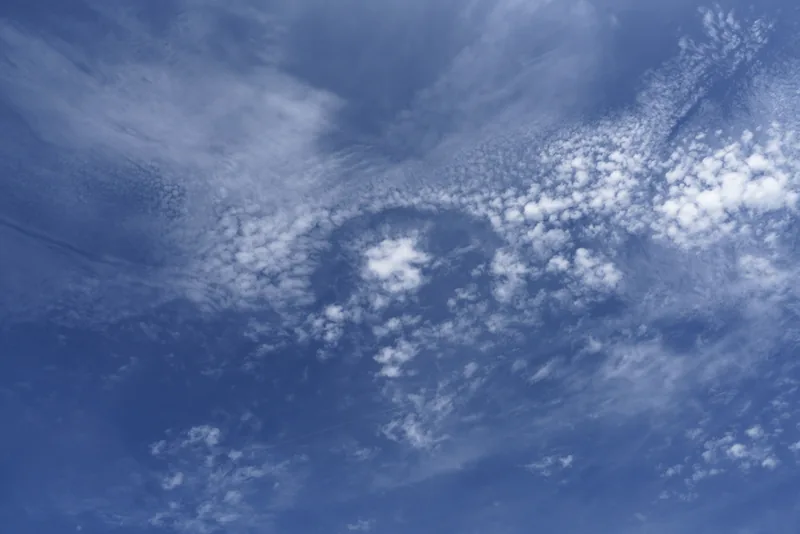
One of five new supplementary features named in the 2017 Atlas preface, alongside asperitas, cauda, fluctus and murus. [source] A credited photograph on this site is captioned, on the file, as a fallstreak hole or punch hole cloud, the special form “cavum,” in altocumulus.
How do lenticular clouds form, on the Met Office blog?
The 15 September 2026 blog describes Altocumulus lenticularis as smooth, lens-shaped clouds associated with hills or mountains in stable air, able to stay in much the same position in a mountain wave. [source]
What are mammatus, officially, on that same blog?
“Distinctive pouch-like formations that usually appear beneath a cumulonimbus cloud,” associated with an unstable atmosphere and, most commonly, thunderstorms. [source]
What are noctilucent clouds, on the NASA caption used here?
“High altitude clouds only visible when the Sun is below the Earth's horizon and illuminating them,” photographed from the ISS on 18 July 2024, 258 miles above eastern Turkey.
Why do two NOAA pictures have such short captions?
Because the file pages have titles and dates, and no photographer and no scene caption. This desk does not invent the missing sentences.
Is a 22° halo a cloud type?
No. The credited photograph is of a halo in cirrostratus, formed, the file says, by ice crystals in the upper troposphere. The schools page notes that cirrostratus is a transparent sheet, often with a halo. [source]
Where do storm warnings belong?
On official forecast services, and, in this network, wild-weather events have a hub at storms.im. This is a cloud-types desk.
Enjoyed a desk of official cloud genera, two height tables, and a few unusual shapes?
No pop-ups. No intrusive advertising. Just interesting stuff. A little support helps the next climates.im site get built.