Made by us
Clouds people make
Some clouds have a human cause. Aircraft draw lines and punch holes. Ships write in the clouds over the ocean. None of them is a conspiracy, and all of them are measured.
Contrails
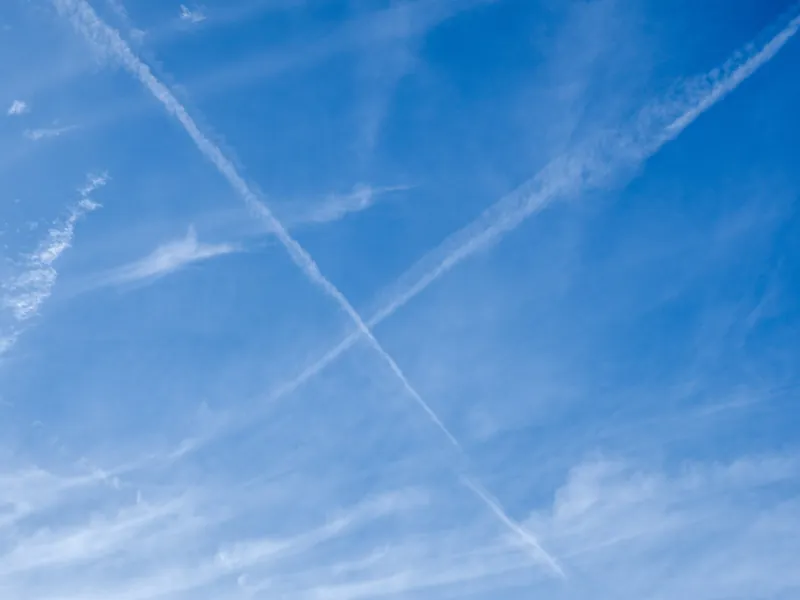
Contrails, short for condensation trails, are long thin lines of cloud usually seen behind an aircraft. The Met Office says they are created from water vapour coming out of the engines. If the air is humid, the droplets or ice crystals stay where they are and often spread out, leaving a fluffy trail where the aircraft has passed. [Met Office, contrails] They are not large enough to cause any weather on the ground. [Met Office, contrails]
Strictly speaking there is only one type of contrail, but the Met Office describes a lookalike. Wingtip vortices can lower the pressure and temperature enough to condense water into a thin line that looks just like a contrail. Unlike contrails, they are usually seen only at low altitude, where an aircraft is flying slowly after take-off or before landing. [Met Office, contrails]
Contrails need very cold air. An NCAR study in 2011 notes that they occur at about −40°C or below. [NCAR 2011]
Hole-punch clouds
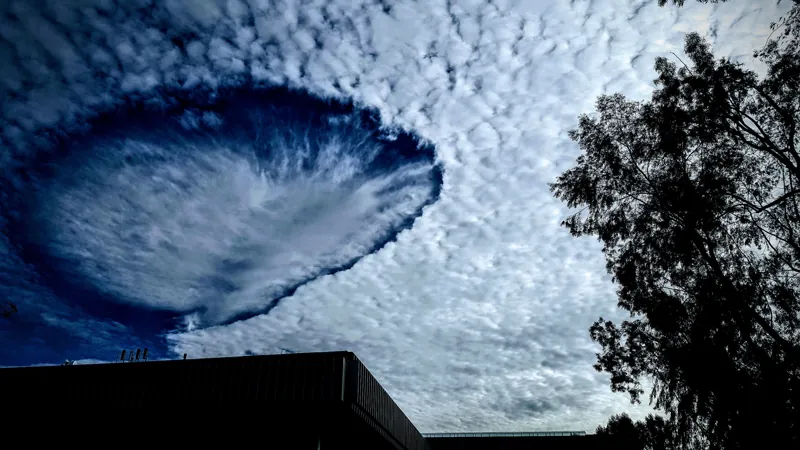
A fallstreak hole, or hole-punch cloud, is a neat round gap in a layer of cloud, often with a wisp of falling ice in the middle. The Met Office explains that it forms when part of a cloud layer turns to ice crystals big enough to fall out. The layer is made of supercooled water: droplets below freezing that have not frozen, because they need a tiny particle to freeze on or must be cooled below −40°C. [Met Office, fallstreak hole] An aircraft punching through can make the air expand and cool as it flows over the wings or propeller, and that can be enough to make the supercooled droplets freeze and fall. [Met Office, fallstreak hole]
The aircraft link was confirmed by a team led by Andrew Heymsfield of the National Center for Atmospheric Research. According to NCAR, a turboprop plane can do it in a cloud layer at about −15°C or colder, as air expands behind its propeller tips; jets need colder layers, below about −20 to −25°C, with the cooling happening over the wings. This effect is unrelated to contrails. [NCAR 2011]
The planes can even make it snow. Looking within 100 km of six airports, London Heathrow, Frankfurt, Paris Charles de Gaulle, Seattle-Tacoma, Chicago O’Hare and Yellowknife in Canada, as well as Byrd Station in Antarctica, the team found that the right conditions exist up to 6 percent of the time, a little more often in colder climates. In one case, radar showed an enhanced snowfall rate of close to an inch an hour after several planes had passed through. [NCAR 2011]
Ships that write in the sky
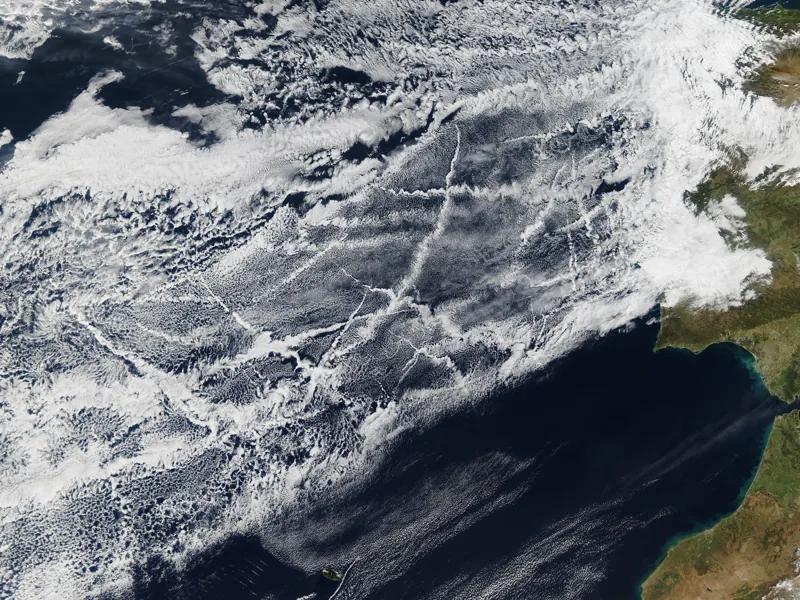
From space, the low clouds over busy oceans are sometimes scored with bright lines. These are ship tracks. NASA’s Earth Observatory explains that they form when water vapour condenses around tiny particles of pollution that ships emit, or that form from gases in the exhaust. Some of these particles, especially sulfates, dissolve in water and become the seeds of cloud droplets. [NASA Earth Observatory, ship tracks]
Clouds full of ship exhaust have more and smaller droplets than clean clouds, so light hitting them is scattered in more directions and they look brighter and thicker. Clean marine clouds are usually seeded by larger natural particles such as sea salt. [NASA Earth Observatory, ship tracks] Off Spain and Portugal in January 2018, so many ships had passed that the clouds were brightened into a patchwork, and individual tracks were hard to pick out. [NASA Earth Observatory, ship tracks]
Why this matters: brighter clouds reflect more sunlight. NASA scientists have identified the conditions that affect how bright ship tracks get. [NASA Earth Observatory, ship tracks] See clouds and climate.
Enjoyed a desk of official cloud genera, two height tables, and a few unusual shapes?
No pop-ups. No intrusive advertising. Just interesting stuff. A little support helps the next climates.im site get built.