Off-world weather
Clouds on other worlds
Earth is not the only world with clouds. Here is what NASA’s own pages say about the others, from sulfuric acid to dry ice to frozen methane.
Venus: acid clouds over a hot rock
From a distance Venus looks peaceful, but NASA describes a world of intense heat, crushing atmospheric pressure and clouds of corrosive acid. [NASA, Venus facts] The atmosphere is mostly carbon dioxide, with dense clouds of sulfuric acid, and its runaway greenhouse effect makes the surface about 467°C, hot enough to melt lead. [NASA, Venus facts] At the tops of the clouds, winds have been measured at up to 360 km an hour, whipping the clouds right round the planet. [NASA, Venus facts]
Could anything live up there? NASA notes that astrobiologists have wondered, and that Russian Venera probes found particles in the lower atmosphere about a micron long, roughly the size of a bacterium on Earth. It is careful to add that none of these findings is compelling evidence of life in Venus’s clouds. [NASA, Venus facts]
Mars: clouds of dry ice
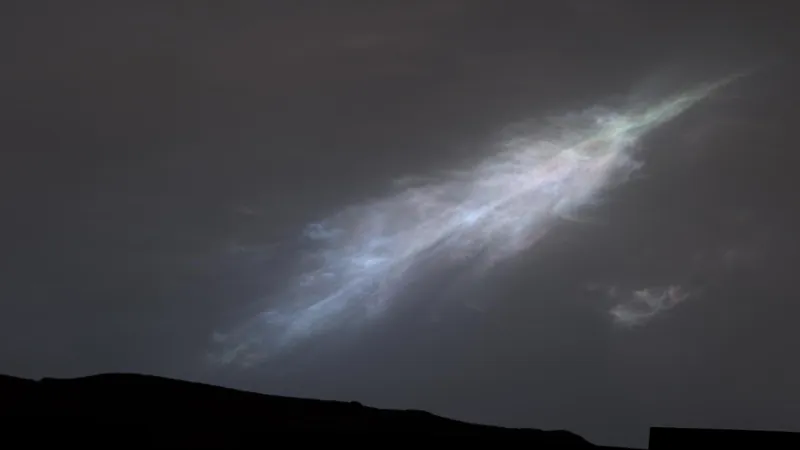
Mars has thin clouds, and NASA’s Curiosity rover photographs them. According to NASA’s Jet Propulsion Laboratory, most Martian clouds float no more than about 60 km up and are made of water ice. In 2021, though, Curiosity caught clouds that arrived earlier and formed higher than expected, where it is so cold that they are probably made of frozen carbon dioxide: dry ice. [NASA JPL 2021] Some of them shimmered with colour as the setting Sun lit them. [NASA JPL 2021]
Jupiter and Saturn: stripes of cloud
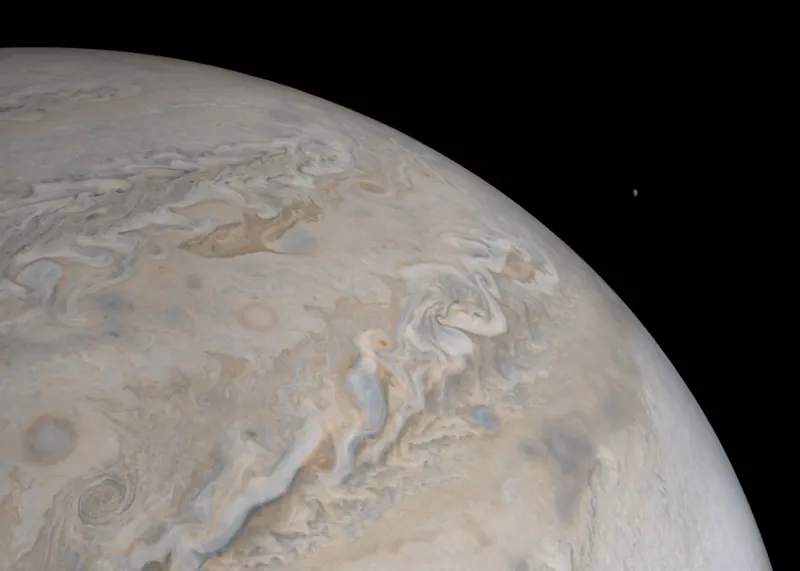
Jupiter’s famous stripes and swirls are, in NASA’s words, cold, windy clouds of ammonia and water floating in an atmosphere of hydrogen and helium. [NASA, Jupiter facts] The bands of colour that circle the planet are cloud bands, and the spots are cyclonic storms dotting it from pole to pole. [NASA, Jupiter facts] Saturn is blanketed in clouds too, which appear as faint stripes, jet streams and storms. [NASA, Saturn facts]
Uranus and Neptune: methane in a hurry
On Neptune, NASA says, winds whip clouds of frozen methane across the planet at more than 2,000 km an hour, and scientists think there may be an ocean of super-hot water under its cold clouds. [NASA, Neptune facts] Uranus looked bland to Voyager 2 in 1986, which saw only a few clouds and dark spots; more recent observations show dynamic clouds as the planet approaches equinox, including bright features that change quickly. [NASA, Uranus facts]
Titan: a moon where it rains
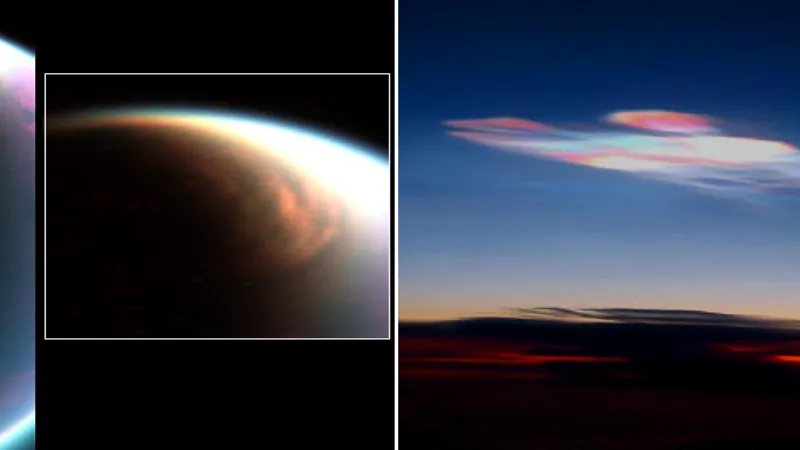
Titan, Saturn’s largest moon, is the only moon in the solar system known to have a substantial atmosphere. [NASA, Titan] NASA says it has clouds, rain, rivers, lakes and seas, not of water but of liquid hydrocarbons such as methane and ethane. [NASA, Titan] Cassini even spotted an ice cloud high over Titan’s north pole that NASA compared with the polar stratospheric clouds over Earth, the family that includes the mother-of-pearl clouds.
What is not on this page: no planet’s clouds are described here beyond what NASA’s own pages say. Try sorting them in Which world?
Enjoyed a desk of official cloud genera, two height tables, and a few unusual shapes?
No pop-ups. No intrusive advertising. Just interesting stuff. A little support helps the next climates.im site get built.