Names and the people behind them
The cloud namers
For most of history a cloud was just a cloud: too changeable, people thought, to sort into kinds. Then a London chemist gave a talk, a German poet wrote him a poem, and two centuries later a society of cloud-lovers got a new cloud into the rule book.
Luke Howard’s lecture
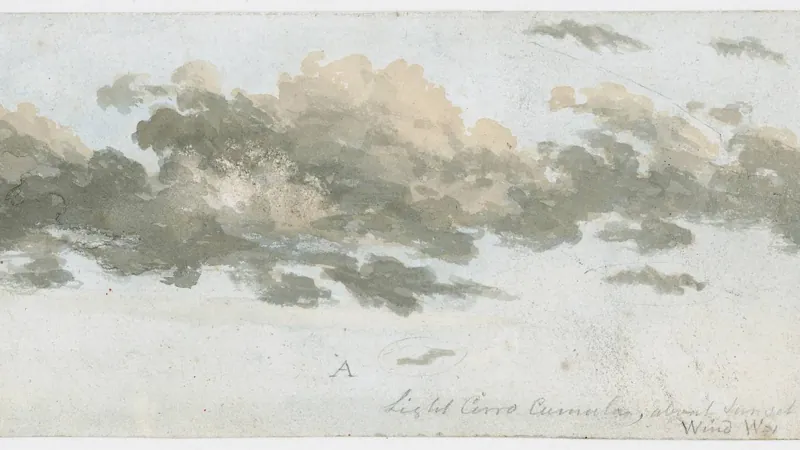
Before the nineteenth century, the Science Museum says, many people thought of each cloud as unique and unclassifiable, and clouds were recorded by their colour or by individual description. [Science Museum Blog 2014] That changed in 1802, when Luke Howard, a commercial chemist, lectured “On the Modification of Clouds” to the Askesian Society, a scientific club founded by three young London Quakers. [Science Museum Blog 2010] He proposed that clouds could be reduced to just three families: cumulus, stratus and cirrus, with combinations, and clouds changing from one kind to another. [Science Museum Blog 2010] In Latin, cumulus means heap, stratus means layer and cirrus means a curl of hair. [Science Museum Blog 2014]
Howard (1772–1864) wrote his names in what he called the “universal language” of Latin, superseding Lamarck’s colloquial French version. [Science Museum Group Journal 2014] The Met Office’s archive adds that he was keen that his names should bear no resemblance to religious terms. [Met Office archive] The lecture was printed almost at once, in three parts in the Philosophical Magazine in the second half of 1803. [Science Museum Group Journal 2014] He was hailed as a genius who had brought the clouds within reach of science. [Science Museum Blog 2010] The Met Office still says the idea of splitting clouds into types was first proposed by him. [Met Office, Clouds]
A poem for Mr Howard
Johann Wolfgang von Goethe, the German poet and naturalist, was so impressed that he wrote a poem, “In honour of Howard”, with verses for each cloud type and one for Howard himself. The Met Office archive quotes it in translation: “But Howard gives us with his clear mind / The gain of lessons new to all mankind.” [Met Office archive] When Howard’s essay was reprinted in its definitive form in 1865, after his death, Goethe’s poem was printed alongside it. [Science Museum Group Journal 2014] The Science Museum adds that Howard’s essays also stirred the imagination of the poet Percy Shelley, and that historians have argued the painter John Constable was influenced by his ideas. [Science Museum Blog 2014]
From three families to ten genera
Howard’s system grew. The Met Office says the World Meteorological Organization extended it to ten main groups of clouds, called genera. [Met Office, Clouds] The reference book for the official names is the International Cloud Atlas, first published in 1896 and updated every few decades, as the Cloud Appreciation Society puts it. [Cloud Appreciation Society] The ten genera are on our genera page.
The cloud that the public found
In 2008 the Cloud Appreciation Society, a club for people who like looking up, proposed a new cloud under the name asperatus, “roughened”. [Cloud Appreciation Society] Gavin Pretor-Pinney, a visiting fellow at Reading, then led a ten-year campaign for recognition. He worked with a science team led by Professor Giles Harrison at the University of Reading to analyse photographs sent in by members of the public. The work showed that asperitas is a low-level water cloud whose shape is caused by waves in the atmosphere. [University of Reading 2017]
In 2017 asperitas joined a group of the first new clouds classified by the WMO since 1951. [University of Reading 2017] “Asperitas was first identified with the help of citizen science, enabled by modern technology,” Pretor-Pinney said. [University of Reading 2017] The Met Office now calls asperitas the newest cloud type, rare and resembling rippling ocean waves, with a base at about 4,000 to 10,000 feet, and says how it forms is still something of a mystery. [Met Office, asperitas]
Two names, one cloud: the society first proposed asperatus; the Atlas adopted asperitas, as a supplementary feature rather than a new genus. See unusual clouds.
You can name one too (sort of)
You do not need to be a scientist to help. The asperitas story shows that photographs sent in by ordinary cloud spotters can change the official list. [University of Reading 2017] Next time the sky looks odd, take a picture, note the date and place, and check it against the ten genera.
Enjoyed a desk of official cloud genera, two height tables, and a few unusual shapes?
No pop-ups. No intrusive advertising. Just interesting stuff. A little support helps the next climates.im site get built.